Free Kick Technique Breakdown: Knuckleball vs Placement

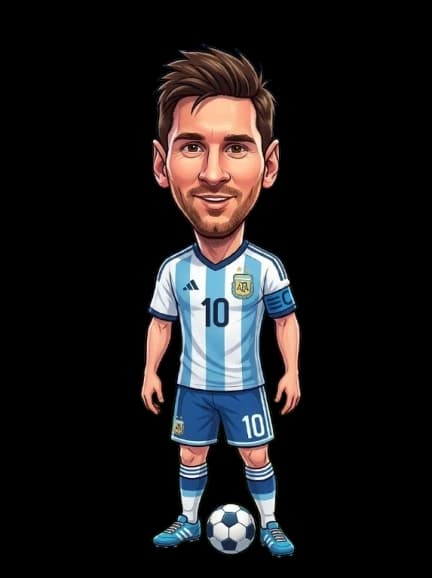

Put Lionel Messi and Cristiano Ronaldo over a direct free kick and the difference is visible before either player strikes the ball. The stance, the run-up, the contact and the intended flight path all suggest two very different solutions to the same problem: how do you put a stationary ball beyond a wall and past a goalkeeper?
Ronaldo became famous for a powerful, relatively low-spin technique that could make the ball dip or move unpredictably. Messi developed a contrasting method built around controlled spin, elevation and precise placement. Both approaches can produce spectacular goals, but the physics behind them are not the same.
That distinction is important because free kicks are often described with simple words such as “power,” “curve” or “knuckleball.” The reality is more complicated. The speed of the ball matters. So does spin. So does the angle of the strike, the position of the foot at contact, the launch angle and what happens to the airflow around the ball during its flight.
A direct free kick gives the attacking player an unusual advantage: the ball is stationary. There is no defender trying to tackle the player during the strike, and the kicker can decide exactly how to approach the ball.
But the wall creates an immediate problem. A shot travelling directly toward the goal may be blocked before it reaches the goalkeeper. The kicker therefore has to manipulate the trajectory enough to get the ball around or over the wall while still bringing it down inside the frame of the goal.
At the highest level, the margin for error is tiny. A strike that is only slightly too high can clear the crossbar. A ball with insufficient bend can hit the wall. Too much power without enough control can turn a promising position into a harmless shot.
Cristiano Ronaldo became one of the most recognisable practitioners of the soccer knuckleball during his Manchester United and early Real Madrid years.
The important word is spin. A traditional curling free kick deliberately creates significant rotation, allowing aerodynamic forces associated with the Magnus effect to bend the ball. A knuckleball attempts to minimise that rotation instead.
Scientific research describes soccer knuckleballs as low-spin or nearly non-spinning shots whose trajectories can become unstable and difficult to predict. Researchers have observed lateral movement, rapid changes in direction and sudden drops associated with the airflow and vortex behaviour around the ball.
That means the famous Ronaldo free kick was not simply “a powerful shot that swerves.” The interesting part was the attempt to strike the ball in a way that reduced stabilising spin and allowed aerodynamic instability to become part of the trajectory.
What Controls a Knuckleball?
Research into knuckling shots has found that a low-spin football can experience fluctuating forces as vortices form and change around its surface. One study specifically examined the phenomenon in connection with Ronaldo’s famous free-kick style.
A spinning football has a relatively predictable aerodynamic effect. The rotation changes the pressure around the ball and creates a force that can bend its path. That is why a player can deliberately produce a curling free kick.
A knuckleball behaves differently. With very little spin, the airflow around the surface becomes less stable. Small changes in the wake behind the ball can influence its movement, making the trajectory less predictable.
For a goalkeeper, this is the nightmare scenario. The keeper has to read the flight early enough to begin the dive, but a ball that changes its path during the final part of its journey can make that initial decision wrong.
The effect should not be exaggerated. A knuckleball does not magically zigzag on every attempt, and not every spectacular Ronaldo free kick was a textbook knuckleball. But the underlying low-spin phenomenon is real and has been studied experimentally.
Ronaldo’s free-kick reputation was built through a sequence of memorable goals rather than one isolated strike. His Manchester United years introduced the technique to a global audience, while his Real Madrid career produced several spectacular examples at the highest level.
His 2009 Champions League free kick against Arsenal became particularly famous because of the combination of distance and speed. UEFA later included the strike among its notable Champions League free kicks.
The important point is that Ronaldo’s reputation did not come only from the number of goals. The visual identity of the technique mattered too. The wide stance, measured approach and violent contact created a recognisable routine that became part of football culture.
Messi’s free kicks developed in almost the opposite direction.
Rather than trying to make the ball unpredictable through minimal spin, Messi generally seeks to make the trajectory predictable for himself but extremely difficult for the goalkeeper to stop. The ball is struck with controlled spin so that it can rise, bend around the wall and then dip toward the target.
Barcelona’s official records repeatedly highlighted the precision of Messi’s technique. In 2021, the club documented his 50th direct free-kick goal for Barcelona and described the routine behind the strike: a short run-up, controlled approach and precise execution from around 23 metres.
The key difference is therefore not simply “power versus accuracy.” Ronaldo also needed accuracy, and Messi also generated significant ball speed. The deeper distinction is how the ball is manipulated after contact. Ronaldo’s famous knuckleball sought reduced spin and unstable movement. Messi’s signature free kick relies much more heavily on controlled spin and a repeatable curved trajectory.
When a football rotates while travelling through the air, the rotation affects the airflow around the ball. This can create a force commonly described through the Magnus effect, causing the trajectory to bend.
For a curling free kick, the kicker wants enough spin to create significant movement while still maintaining enough speed and control to get the ball over or around the wall.
That is where Messi’s technique becomes difficult to replicate. The objective is not simply to “put spin on the ball.” The amount and direction of spin have to work together with the launch angle and speed. Too little movement and the goalkeeper saves it. Too much curve and the ball misses the target.
This is perhaps the cleanest way to understand the contrast.
That distinction also explains why the two free-kick styles look so different on television. Ronaldo’s best attempts can appear to fly almost directly before suddenly dropping or shifting. Messi’s best attempts often look more graceful because the curve is visible throughout the flight.
One of the most interesting parts of this rivalry is how dramatically the balance changed over time.
When Messi became Barcelona’s all-time leading scorer in March 2012, the free-kick comparison looked completely different. Messi had only five direct free-kick goals for Barcelona at that point according to the detailed historical record cited by MessiVsRonaldo.app, while Ronaldo had already accumulated a much larger total.
Then Messi’s dead-ball production accelerated. He scored seven direct free kicks during 2012, and the following years transformed him from a talented free-kick taker into one of the defining specialists of his generation.
The Free-Kick Turning Point
The important story is therefore not that Messi was always superior from dead balls. He was not. Ronaldo dominated the early part of their rivalry, while Messi eventually developed a remarkable level of consistency from free-kick positions.
The current career comparison is striking because the player who once trailed by a large margin eventually moved ahead.
Career Direct Free-Kick Goals
The current comparison gives Messi 71 direct free-kick goals and Ronaldo 63 in the source dataset. That eight-goal gap is interesting, but the timeline is even more revealing than the final number.
Ronaldo built his early advantage during his Manchester United and early Real Madrid years. Messi then experienced a prolonged period of elite free-kick production that eventually changed the overall ranking.
Free-kick accuracy is not simply an instinctive gift. It can be developed through repetition, experimentation and technical refinement.
Messi’s evolution is particularly interesting because his broader football style already depended on manipulating the ball with small changes in angle and speed. The same technical sensitivity that helped him dribble, pass and finish could be applied to a stationary ball.
His run-up remained relatively compact. The goal was not to generate maximum possible force but to create a repeatable contact point and a reliable relationship between the foot, ball and target.
That repeatability matters enormously. A free-kick specialist does not need one spectacular goal every 50 attempts. The real advantage comes from repeatedly producing shots that travel into the small areas of the goal that a goalkeeper struggles to cover.
Ronaldo’s knuckleball became famous enough that thousands of amateur players attempted to reproduce it. The problem was that the technique is extremely sensitive to the quality and location of contact.
A low-spin strike has less aerodynamic stability. That is part of its appeal, but it is also the source of its difficulty. A small change in contact can alter the ball’s speed, rotation or trajectory enough to turn a dangerous free kick into a shot that never threatens the goal.
Research into Ronaldo’s representative knuckleball has even been used to model the trajectory mathematically. A recent study reconstructed a Ronaldo free kick from video data and examined its velocity, drag and flight characteristics.
Goalkeeping against a free kick is partly a prediction problem. The keeper cannot wait until the ball has completed its entire flight before deciding where to move.
Against a conventional curling shot, the keeper can often estimate the trajectory from the initial direction, spin and body position of the kicker. Against a low-spin knuckleball, the flight can be less stable, making that prediction more difficult.
The goalkeeper therefore faces a choice: commit early and risk being fooled by late movement, or wait longer and risk not having enough time to reach the ball.
Messi creates a different problem. The goalkeeper may have a better idea of the general shape of the trajectory, but that does not mean the ball is reachable.
A perfectly struck curling free kick can clear the wall and bend toward the upper corner with enough precision that the keeper’s starting position becomes crucial. The shot is not necessarily unpredictable; it is simply placed in a location that leaves almost no reaction margin.
This is why calling Messi’s method “precision over power” is more useful than saying he simply “curves the ball.” The entire technique is about controlling the variables well enough to make the target extremely small.
Not every free-kick position is suitable for the same technique.
From closer range, a player can concentrate heavily on placement and curl. From farther away, the ball needs enough initial velocity to reach the target before losing too much speed. The defensive wall also becomes part of the calculation because the kicker needs sufficient height to clear it while still bringing the ball back down in time.
This is another reason a single free-kick conversion number cannot fully describe a specialist. The difficulty of the attempts matters, as does the location and angle of the foul.
There is another variable that is easy to forget: the football has changed.
Modern footballs have different panel structures, surface textures and aerodynamic characteristics from balls used earlier in Messi and Ronaldo’s careers. Research into knuckleballs has specifically noted how changes in football design can affect aerodynamic behaviour.
That means comparing a free-kick specialist across a 15- or 20-year career is not perfectly equivalent to comparing identical equipment throughout. The player is adapting not only to opponents and tactics but also to the ball itself.
If you only look at the final career numbers, Messi’s 71 versus Ronaldo’s 63 tells you who currently has the larger total in the source dataset. It does not explain how the rivalry reached that point.
The more interesting story is the reversal. Ronaldo established an early advantage and became one of the most recognisable free-kick specialists of the late 2000s and early 2010s. Messi then dramatically improved his output after 2012 and eventually overtook him.
That makes the rivalry useful as a case study in technical evolution. Great specialists are not necessarily born with a finished technique. They can change their mechanics, experiment with different contact points and build new levels of consistency over thousands of repetitions.
There is no universal answer because the techniques solve slightly different problems.
Ronaldo’s knuckleball is attractive because of its uncertainty. When the contact is right, the goalkeeper can be presented with a ball whose late movement makes a conventional save extremely difficult.
Messi’s method is attractive for the opposite reason. The ball follows a carefully engineered path. The challenge is not necessarily to surprise the goalkeeper about where the ball is going, but to put it exactly where the goalkeeper cannot reach.
*Career totals shown here follow the MessiVsRonaldo.app dataset used for this article. Free-kick databases can differ slightly depending on how historical competitions and direct free kicks are classified.
In the career dataset used for this article, Lionel Messi leads with 71 direct free-kick goals compared with Cristiano Ronaldo’s 63. Historical totals can vary slightly between databases depending on classification.
Some of Ronaldo’s famous free kicks closely resemble the low-spin knuckleball studied in sports-science research. The technique attempts to minimise spin, which can make the ball’s flight less stable and more difficult to predict. Not every Ronaldo free kick should automatically be classified as a textbook knuckleball.
Messi generally creates significant spin when striking the ball. The rotating ball interacts with the airflow around it, producing aerodynamic forces that bend its trajectory. The exact result depends on the amount and direction of spin, contact point, speed and launch angle.
Ronaldo held the clear early advantage. When Messi became Barcelona’s all-time leading scorer in 2012, the historical free-kick dataset used here had Ronaldo far ahead. Messi’s production then increased dramatically during the following years.
Yes. Research on low-spin soccer balls has documented unstable trajectories and fluctuating aerodynamic forces. The effect is linked to changes in the airflow and vortex structures around the ball rather than a deliberate steering mechanism by the player after the kick.
Neither exists in isolation. A shot needs enough speed to reach the target and enough control to stay inside the goal. The ideal balance changes with distance, angle, wall position and the goalkeeper’s position.
Ronaldo and Messi did not become great free-kick takers by mastering the same technique. They reached the same objective through almost opposite ideas.
Ronaldo’s most famous approach reduced spin and used speed, contact and aerodynamic instability to create a difficult flight. Messi’s signature method relied much more heavily on controlled spin, trajectory and placement.
The statistics make the story even more interesting. Ronaldo built a substantial lead during the early years of their rivalry, while Messi’s remarkable development from dead balls eventually took him ahead in the career total used here.
And that is what makes this comparison more valuable than a simple “who scored more?” debate. Their free kicks demonstrate two different approaches to the same technical problem: one tries to make the ball difficult to predict, while the other tries to make the final destination almost impossible for the goalkeeper to reach.
Ronaldo made the knuckleball iconic. Messi turned precision curling into a repeatable weapon. Neither technique is universally superior — but both show how an elite player can turn a stationary ball, a wall and a few metres of grass into one of football’s most spectacular moments.
Detailed career free-kick records and year-by-year comparison between Messi and Ronaldo.
Barcelona’s official account of Messi reaching 50 direct free-kick goals for the club in 2021.
Historical breakdown of Messi’s direct free-kick goals for Barcelona and Argentina.
UEFA selected Messi’s 2019 free kick against Liverpool and Ronaldo’s 2009 strike against Arsenal among its notable Champions League free kicks.
Sports-science research explaining how low-spin knuckleballs behave and why their flight can become unpredictable.
Experimental research examining vortex shedding and fluctuating forces behind soccer-ball knuckleball movement.
Research examining the impact mechanics of low-spin knuckleball shots, including the technique associated with Ronaldo.
Recent modelling research using trajectory data from a representative Cristiano Ronaldo knuckleball free kick.
