The Evolution of Lionel Messi's Position and Role

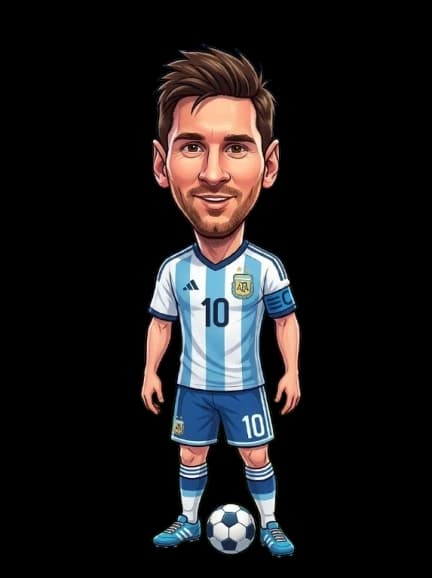

Lionel Messi's position is one of the easiest parts of his career to misunderstand. A team sheet might call him a right winger, a false nine, a number 10 or a forward, but those labels do not always explain what he actually did on the pitch.
Messi's career is better understood as a series of tactical transformations. He began as a small, explosive winger whose main weapon was taking on defenders. He later became a false nine who dropped into midfield and pulled centre-backs out of position. He then developed into a free-roaming creator and goalscorer, and eventually into a deeper playmaker whose biggest influence could come from passing rather than carrying the ball.
The interesting part is that Messi did not lose his old abilities every time his position changed. Instead, he added new responsibilities to the same basic skill set.
The dribbling remained. The passing became more important. The finishing became more efficient. His movement changed. His starting position changed. His defensive workload changed. Most importantly, the areas of the pitch from which he influenced games changed.
This article follows that evolution from Messi's early Barcelona years through the Guardiola era, the MSN years, his final seasons at Camp Nou, Paris Saint-Germain, Argentina's 2022 World Cup triumph and his later career with Inter Miami.
Before looking at Messi's career, it helps to separate a player's starting position from his actual role.
A player can be listed as a right winger but spend most of a match in the middle. A striker can drop into midfield. A number 10 can move toward the wing. A false nine can begin between the opposition centre-backs and then disappear into midfield.
Messi became particularly difficult to classify because his movement was often more important than his starting position.
That is why this article uses terms such as winger, inside forward, false nine, number 10, second striker and playmaker as descriptions of roles rather than permanent labels.
Messi made his official first-team Barcelona debut on October 16, 2004, against Espanyol. He was only 17 years old. Barcelona's own historical record confirms that he came on as a substitute for Deco during that match.
At this stage, Messi was primarily a wide attacker. His small frame, acceleration, close control and low centre of gravity made him extremely difficult to stop when he received the ball facing a defender.
Unlike a traditional wide midfielder whose first responsibility might be crossing, Messi's instinct was to attack the defender. He wanted to receive the ball, move toward the full-back and create a route toward the penalty area.
His early Barcelona role therefore depended heavily on one of his defining characteristics: carrying the ball at speed while keeping it extremely close to his feet.
The numbers from this period also show how quickly his attacking output developed. Barcelona records Messi with 1 official goal in 2004/05, 8 in 2005/06, 17 in 2006/07 and 16 in 2007/08.
Those figures are important because they show that the legendary goalscorer had not appeared fully formed. He was gradually learning how to turn his dribbling ability into goals, assists and repeatable attacking actions.
Messi increasingly became a threat from the right side while playing in a Barcelona 4-3-3. From there, he could receive the ball wide and attack inside onto his stronger left foot.
This is the basic idea behind an inverted winger: instead of receiving on the same side as his stronger foot and naturally moving toward the outside, the player starts on the opposite side and has a direct route toward the centre.
For Messi, that movement opened several options at once. He could dribble diagonally toward the box, combine with a midfielder, play a through ball, shoot with his left foot or continue toward the byline.
The important change was that Messi was no longer simply a winger trying to create chances from the outside. He was becoming a wide forward whose starting position was designed to give him access to the most dangerous central areas.
The defining positional transformation of Messi's career came under Pep Guardiola.
In 2009, Guardiola famously moved Messi into a central false-nine role. UEFA describes the change clearly: Messi moved in from the right and occupied a deeper position between Real Madrid's midfield and defence during Barcelona's 6–2 victory at the Santiago Bernabéu.
The idea behind the false nine was simple but extremely difficult to defend.
If a centre-back followed Messi into midfield, space appeared behind him for Barcelona's wide forwards and midfield runners. If the centre-back stayed in the defensive line, Messi could receive the ball between the lines, turn and attack the defence directly.
That created a problem with no comfortable solution.
Follow Messi and you risk opening space behind you. Leave him alone and you give one of the best dribblers and passers in football time to face the defence.
The false nine role combined almost every major attacking quality Messi possessed.
He could receive between the lines because his close control made pressure difficult to apply. He could turn and dribble because his acceleration allowed him to attack retreating defenders. He could pass behind the defence because he could see runners from a central position. And he could finish attacks himself when defenders focused too heavily on his teammates.
This is why the false nine period is often considered the most complete expression of Messi's attacking skill set.
UEFA noted that Messi's move from an inverted right-wing role to the false nine position helped produce an extraordinary increase in his goalscoring. UEFA records 173 goals for Messi across the three seasons following Guardiola's central shift.
The statistical change was extraordinary.
Barcelona records Messi's official goals across this part of his career as 38 in 2008/09, 47 in 2009/10, 53 in 2010/11 and 73 in 2011/12.
The 2011/12 season was the extreme example. Messi scored 73 official goals for Barcelona, including 50 in La Liga and 14 in the Champions League.
Those numbers should not be interpreted as proof that the false nine position alone caused his scoring explosion. Barcelona's quality, teammates, possession model, chance creation and Messi's own development all mattered.
But the tactical change clearly created an environment in which Messi could influence almost every part of an attack.
One of the unusual things about Messi's false-nine role was that he did not have to choose between being a playmaker and being a scorer.
A traditional number 9 usually spends much of his time trying to occupy centre-backs and attack the penalty area. A traditional number 10 usually spends more time receiving the ball outside the box and creating chances.
Messi could perform both jobs during the same attack.
He could drop deep to start the move, carry the ball through midfield, combine with a teammate and then continue the attack into the box to finish it.
That made his role unusually difficult to compare with conventional positional definitions.
The arrival of Luis Suárez in 2014 created another major tactical change.
Barcelona now had a natural central striker who could occupy centre-backs, attack crosses, make runs behind the defence and combine with Messi and Neymar.
Suárez's presence allowed Messi to move more freely again.
Messi could begin from the right but move inside whenever the opportunity appeared. Suárez could stretch the central defenders, while Neymar provided another attacking outlet from the left.
The result was one of football's most famous attacking partnerships: Messi, Suárez and Neymar, commonly known as MSN.
Barcelona's own records show that the trio scored 122 goals in 2014/15 and 131 in 2015/16. Those figures underline the enormous attacking output produced by the front three.
The important tactical point is that Messi did not need to remain permanently central because Suárez occupied the striker position.
This gave Messi room to become something between a winger, number 10 and second striker.
During the MSN years, Messi's starting position on the right was less important than what happened after he received the ball.
He could move inside into the half-space, combine with Suárez, exchange passes with Neymar, find Jordi Alba's runs or create shooting opportunities from the edge of the box.
This was not the same Messi as the early Guardiola false nine. The central striker role now belonged primarily to Suárez.
Instead, Messi became a more flexible attacking creator who could start wide and gradually take control of the centre of the pitch.
After Neymar left Barcelona in 2017, the team's attacking structure changed again.
Barcelona used different combinations involving players such as Luis Suárez, Ousmane Dembélé, Philippe Coutinho, Antoine Griezmann, Arturo Vidal and Ansu Fati.
Messi's role therefore became increasingly dependent on the players around him.
At times he started from the right. At other times he played closer to Suárez. He could operate centrally as a creator, drop deeper to collect the ball or begin an attack from the right half-space before moving toward the middle.
The common feature was freedom.
Messi increasingly became the player through whom Barcelona's attacking decisions flowed.
This is one reason his position is difficult to describe with a single number.
As Messi became more involved in build-up play, another part of his game became increasingly important: passing from deeper positions.
Instead of always receiving the ball near the penalty area, he could drop toward midfield and become the player responsible for progressing the attack.
This created a trade-off.
The deeper Messi moved, the more influence he could have on the beginning of an attack. But the farther he was from goal, the more distance he had to cover before becoming the final receiver.
The late Barcelona Messi increasingly accepted that trade-off because his passing had become good enough to make the deeper position valuable.
Messi's move to Paris Saint-Germain in 2021 placed him in a very different tactical environment.
PSG already had Neymar and Kylian Mbappé, meaning the attack contained several players who preferred to receive the ball in advanced areas.
Under Mauricio Pochettino, Messi was often used from the right side within PSG's attacking structure. However, the position should not be interpreted as meaning he suddenly became a traditional touchline winger again.
Messi still wanted to move inside and participate in build-up play. The difference was that PSG's overall structure did not always give him the same control over the game that Barcelona's possession system had previously provided.
The tactical balance changed again under Christophe Galtier, particularly as PSG experimented with a more fluid attacking structure involving Messi, Neymar and Mbappé.
Messi's role increasingly combined chance creation, ball progression and finishing rather than asking him to remain permanently wide.
Messi's role for Argentina during the 2022 World Cup provides another important example of his evolution.
He was not simply a traditional striker waiting inside the penalty area. He frequently moved into central and right-sided spaces, dropped toward the ball and then attacked the final third when Argentina created an opening.
This allowed Argentina to use his passing and ball-carrying ability while also keeping him close enough to goal to finish attacks.
FIFA records that Messi led Argentina to the 2022 World Cup title, won the adidas Golden Ball and became the first player to win that award twice.
The tournament was also a useful demonstration of how much his game had changed. The younger Messi had often depended on explosive dribbling to create separation. The older Messi could manipulate defenders with changes of speed, body movement, positioning and passing.
Perhaps the biggest difference between young Messi and mature Messi is not simply where he stood.
It is how he created advantages.
The young Messi could destroy a defensive structure through acceleration and repeated dribbles.
The mature Messi could destroy the same structure with one pass.
He became increasingly comfortable slowing a match down, waiting for a defender to move and then exploiting the space created by that movement.
That is a major reason why Messi's career did not simply decline as his physical explosiveness changed.
His game became more dependent on anticipation, technique, passing and decision-making.
Messi joined Inter Miami in 2023, entering another stage of his career in which his role could be described less by a fixed position and more by his freedom to influence the game.
He can begin from the right, operate centrally or drop deeper depending on the phase of play. The important point is that he is no longer expected to spend the entire match repeatedly beating defenders from a fixed wide position.
Instead, his value increasingly comes from choosing when to accelerate, when to pass, when to carry the ball and when to arrive near goal.
Inter Miami's later tactical structure has allowed Messi to remain one of the team's central creative figures while conserving some of the physical energy that was required from him during the most demanding periods of his Barcelona career.
That does not mean Messi has stopped being a scorer. It means that scoring is now one part of a broader playmaking role.
The young Messi needed space to accelerate.
The mature Messi often needs only a small pocket of space to create something.
That difference explains why his position has become increasingly fluid.
A traditional winger depends heavily on speed and repeated wide actions. A traditional striker depends heavily on penalty-box movement. A traditional number 10 depends heavily on receiving between the lines.
Messi has spent significant parts of his career doing all three.
The easiest way to understand the entire evolution is to divide it into stages.
Main characteristics: direct dribbling, acceleration, one-on-one attacking and movement from the right toward the centre.
Main characteristics: dropping between midfield and defence, creating numerical problems for centre-backs, combining playmaking with goalscoring.
Main characteristics: central creation, right-sided starting positions, combination play and increased responsibility for both goals and assists.
Main characteristics: deeper involvement, control of possession, playmaking from central and right-sided areas and reduced dependence on fixed positioning.
Main characteristics: wide starting positions mixed with central movement, chance creation and finishing within a front line containing multiple elite attackers.
Main characteristics: freedom to move inside, deep creation, passing, controlled bursts of dribbling and selective movement toward the penalty area.
Every tactical transformation gave Messi something new.
The early winger role gave him space to attack defenders.
The false nine role gave him access to the centre of the pitch.
The MSN structure gave him freedom to combine with a genuine central striker.
The later Barcelona role gave him control over more of the attacking process.
PSG forced him to adapt to a different collection of attacking stars.
Inter Miami has allowed him to maximise his experience, passing and decision-making while choosing his moments of physical intensity.
The evolution also involved trade-offs.
The older Messi does not repeatedly attack defenders with the same explosive frequency as the teenager who first broke into Barcelona's team.
He also covers less ground defensively than he did during some earlier stages of his career.
But those changes are part of the reason his career has lasted so long at an extraordinary level.
Instead of relying on one physical advantage, Messi increasingly relies on reading the game before the next action happens.
If someone asks, “What position does Messi play?”, the honest answer depends on the season, manager, teammates and tactical system.
Right winger is correct for important parts of his early career.
False nine is correct for the Guardiola period.
Number 10 or free attacking midfielder describes parts of his later Barcelona career.
A hybrid forward and creator describes much of his PSG period.
And at Inter Miami, the most useful description is probably a free-roaming attacking playmaker who can still operate as a scorer.
Messi's career demonstrates that elite players do not necessarily remain elite by doing the same things forever.
The young Messi won advantages through acceleration and dribbling.
The Guardiola Messi won advantages through positioning and combination play.
The MSN Messi won advantages through movement, passing and attacking combinations.
The late Barcelona and Argentina Messi increasingly won advantages through vision, timing and control of the game.
The Inter Miami Messi continues that trend, using experience and decision-making to decide when the game needs a pass, a dribble, a shot or a change of tempo.
Messi developed as a wide attacking player and became particularly associated with the right side of Barcelona's attack during his early first-team years.
The defining switch came under Pep Guardiola in 2009. UEFA specifically identifies the 6–2 victory over Real Madrid at the Santiago Bernabéu as the match in which Guardiola deployed Messi centrally as a false nine.
The role allowed him to receive between the opposition midfield and defence, where he could combine his dribbling, passing and finishing. Centre-backs were forced to decide whether to follow him or protect the space behind them.
Not completely. Even after becoming more central, Messi continued to start attacks from wide areas depending on the system. The important difference is that his role became increasingly fluid.
Messi often started from the right side but was given significant freedom to move inside. With Luis Suárez operating centrally and Neymar attacking from the left, Messi could function as a wide forward, creator and second striker during the same match.
Parts of his later Barcelona and PSG careers can reasonably be described as a number 10 or free attacking playmaker role. However, Messi rarely stayed in a traditional fixed number 10 position for an entire match.
His role is fluid. He can begin on the right or in an advanced central position and then drop deeper to help create attacks. His responsibilities are closer to those of a free-roaming attacking playmaker than a traditional touchline winger.
Not necessarily. Moving deeper can reduce the number of immediate shooting opportunities, but it can also give a player more influence over the entire attack. Messi increasingly compensated for physical changes with passing, vision, positioning and decision-making.
His role changed because his physical abilities, tactical systems, managers and teammates changed. Barcelona's teams under Rijkaard and Guardiola were different from the MSN team, which was different again from the late Barcelona, PSG, Argentina and Inter Miami setups.
This article separates confirmed statistics from tactical interpretation. Official goal totals and major achievements are taken from club, competition and award sources where available. Tactical descriptions such as “false nine”, “free role” and “deep-lying creator” are analytical descriptions of how Messi was used rather than official position labels.
Season totals can also differ between databases depending on whether they include only official competitive matches or additional fixtures. For that reason, Goat Arena uses the definition stated with each statistic rather than combining numbers from different statistical definitions.
Lionel Messi's positional evolution is not really a story about moving from one position to another.
It is the story of a player gradually taking control of more and more parts of the game.
He began as a fearless young winger who wanted to attack defenders.
He became an inverted right-wing forward who could cut inside and create.
Guardiola then moved him into the false nine role, where Messi could simultaneously create, dribble and finish.
The arrival of Suárez and Neymar produced another transformation, allowing Messi to become a free-roaming creator from the right while still producing enormous scoring numbers.
During his later Barcelona and PSG years, Messi increasingly dropped deeper and accepted greater responsibility for starting attacks.
With Argentina, particularly during the 2022 World Cup, he showed how effectively experience could replace some of the physical explosiveness of his younger years.
And at Inter Miami, his role has moved even further toward that of a footballing conductor: a player who can decide where the attack should develop, when to accelerate the game and when a single pass is more valuable than another dribble.
The young Messi was defined by how quickly he could move with the ball.
The mature Messi is defined by how quickly he understands the game.
That is the real evolution of Lionel Messi's position and role.
Used for Messi’s Barcelona career records, seasonal scoring figures, Ballon d’Or history and major statistical milestones.
Used for Messi’s seasonal goal totals from 2004/05 through 2013/14, including the 73-goal 2011/12 season.
Used for Barcelona-era records, 73 goals in 2011/12, 50 La Liga goals and Messi’s long-term scoring achievements.
Used for the MSN attacking trio and their combined goal production during the 2014–2017 period.
Used for Messi’s tactical evolution from inverted right-wing forward to false nine under Pep Guardiola.
Used for the tactical context of Guardiola’s 2009 false-nine experiment against Real Madrid.
Used for Messi’s 2022 World Cup achievement, Golden Ball and Argentina’s title.
Used to verify Messi’s eighth Ballon d’Or in 2023.
Used as the official Ballon d’Or historical record.
Used as the club reference for Messi’s Inter Miami period and later-career role.
Used as a supporting statistical reference for season-by-season career data.
